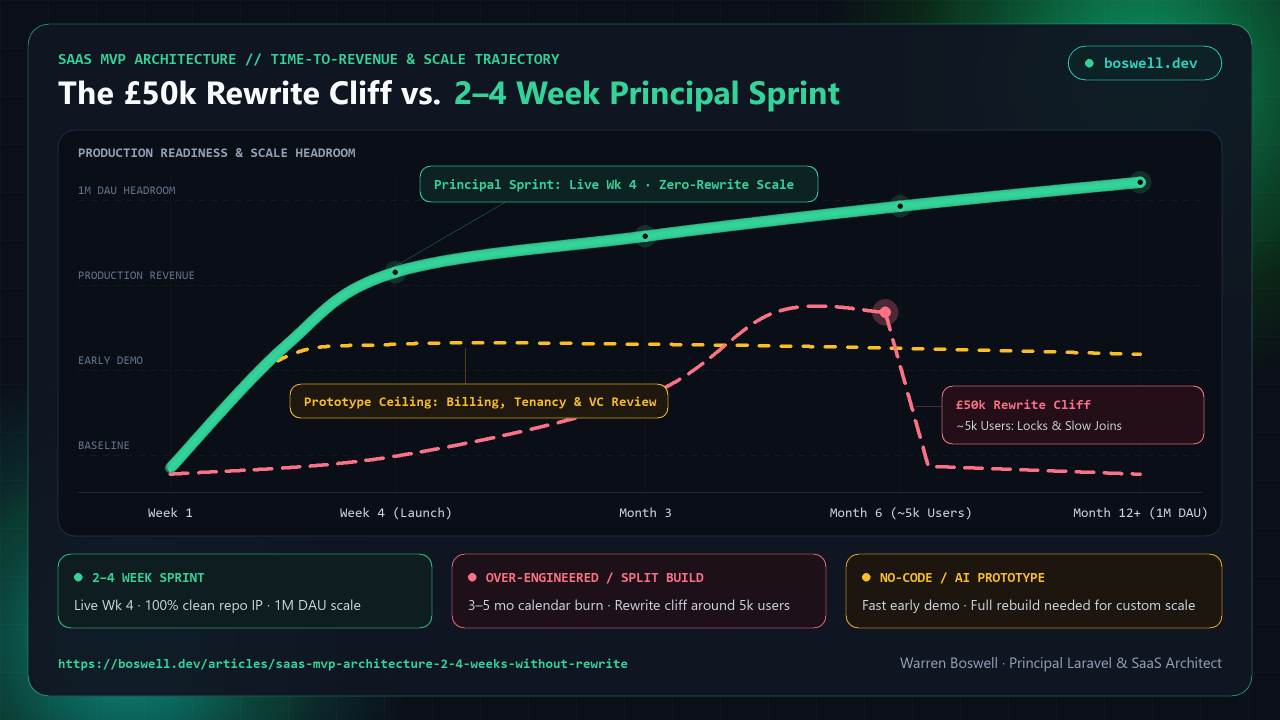
After 14 years running my own software agency (Olivos by Design) and years advising post-seed scale-ups, I have audited dozens of stalled SaaS codebases. Almost every rescue starts with the same story: a founder spent £30,000–£50,000 and four months waiting on an over-engineered or under-indexed first build, only to discover the product locks up at 5,000 active users or fails basic investor technical due diligence.
The tragedy is that founders rarely fail because they moved too fast. They fail because they picked the wrong build model—confusing fewer product features with sloppy engineering foundations.
If you are planning a B2B or B2C SaaS launch in 2026, you can ship a real, revenue-collecting production MVP in 2–4 weeks without painting yourself into a costly rewrite. Explore the engagement blueprint on boswell.dev/founders, or walk through the exact engineering playbook below.
The £50k Rewrite Trap
When early-stage SaaS builds burn runway before finding product-market fit, the cause almost always traces back to two architectural traps:
- Premature architectural split: Splitting a pre-revenue startup into separate React/Next.js frontends and separate backend APIs too early—doubling boilerplate, deployment surface, DTO serialization, and cross-team coordination before customer #1 even exists.
- Treating foundations as "Phase 2" polish: Deferring composite MySQL indexes, idempotent Stripe webhook locking, and strict multi-tenant scoping during rushed early builds—so everything demos fine on 200 seed rows, then locks up around 5,000 active users when concurrent traffic arrives.
At the other extreme, shipping raw no-code or unverified AI-generated prototypes gives fast early demos, then forces a ground-up rewrite the moment you need custom pricing rules, audit trails, SOC 2 controls, or predictable database performance.
| Build Model | Typical Timeline | Cash Burn Risk | IP Ownership & Portability | Scale Ceiling Before Rewrite | Technical Due Diligence Readiness |
|---|---|---|---|---|---|
| Over-Engineered / Split Build | 3–5 months | High (£35k–£60k+ sunk before PMF) | Full repo, often bloated by split SPA/API overhead | Frequently stalls around 2,000–5,000 users | Mixed—often lacks composite indexes & automated tests |
| No-Code / AI Prototype | 1–2 weeks | Low upfront, steep migration cost | Vendor lock-in or brittle generated spaghetti | Breaks on custom billing, multi-tenancy, or joins | Fails investor & enterprise security reviews |
| Principal-Led 2–4 Week Sprint | 2–4 weeks | Lean fixed sprint scope | 100% clean repo IP from commit #1 | Built on patterns proven past 1M DAU | Passes scrutiny out of the box |
The 2–4 Week Zero-Rewrite Sprint Blueprint
Shipping in under a month does not mean rushing. It means ruthlessly trimming product surface area down to one core, revenue-bearing workflow while locking in production foundations on Day 1:
flowchart LR
   W1["Week 1: Schema, Multi-Tenancy & Auth"] --> W2["Week 2: Idempotent Stripe & Core Workflow"]
   W2 --> W3["Week 3: Reactive Livewire UI, Queues & AI"]
   W3 --> W4["Week 4: Pest Suite, Edge Cache & Live Launch"]
Notice what happens when a single Principal Architect writes every migration, service, and UI component directly: there are zero hand-off meetings, zero API contract mismatches between separate frontend/backend teams, and clean git commits ready for your first in-house hires.
01. Multi-Tenant Data Isolation & Composite Indexes on Day 1
Adding workspace_id (or tenant_id) scoping as an afterthought is one of the most expensive retrofits in SaaS engineering. Every operational query, queue job, policy check, and export must enforce tenant boundaries cleanly from migration #1.
Just as critical is how your MySQL 8 indexes are ordered. Single-column foreign keys look fine with 200 seed rows, then collapse into Using filesort and Using temporary table scans once paying tenants accumulate tens of thousands of activity records.
- Day-1 rule: Pair every multi-tenant table with cardinality-ordered composite indexes matching your real
WHEREandORDER BYclauses—for example,(tenant_id, status, created_at DESC, id). - Why it pays off: You avoid premature microservices and keep p95 read latencies under 50ms even as usage grows orders of magnitude. See how this exact relational pattern scales in the High-Availability 1 Million DAU Case Study.
02. Idempotent Stripe Billing & Webhook State Machines
Never bolt billing onto an MVP in Week 4 using naive controller callbacks. In production, Stripe webhooks arrive out of order, retry aggressively after transient timeouts, and collide with customers clicking "Subscribe" twice on flaky mobile connections.
- Day-1 rule: Treat billing transitions as an idempotent state machine: verify cryptographic webhook signatures, wrap settlement transitions in short distributed Redis locks, enforce unique idempotency keys at the MySQL constraint layer, and model subscriptions and credits so duplicate events safely no-op.
- Why it pays off: Zero double-billed customers, clean reconciliation when finance asks questions, and instant support for upgrades, prorations, and seats—patterns battle-tested in our Dual-Rail Fiat & Crypto Payment Gateway Case Study.
03. One Unified Stack Over Premature Split Teams
For 95% of early-stage SaaS products, splitting a small startup into a dedicated SPA repository and a dedicated REST/GraphQL API repository cuts shipping speed in half while adding zero customer value.
Anchoring on Laravel 13, PHP 8.4, Livewire 4, Alpine.js, and Tailwind CSS v4 gives founders a unified full-stack architecture:
- 3× faster feature iteration: Server-driven reactivity streams UI updates and form validation straight from strongly typed PHP components without duplicating validation schemas or managing brittle client state stores.
- Lower cloud burn: A single stateless Laravel cluster behind Nginx and Cloudflare edge caching handles massive concurrency on lean infrastructure before you ever need heavy container orchestration.
- Easy future hiring: Laravel and PHP have one of the deepest global talent pools in web engineering—meaning when you raise Seed or Series A and hire a full-time engineering squad, they inherit clean, idiomatic code they already understand.
04. Asynchronous Queues & Bounded AI Features
Almost every modern SaaS MVP benefits from practical AI—parsing supplier PDFs, qualifying inbound quote requests, summarizing customer health, or triaging support events—but naive synchronous LLM calls cause 504 browser timeouts and unpredictable bills.
- Day-1 rule: Keep AI strictly behind server-side Laravel proxies, isolate long-running tasks onto Redis queues, route across fallback models with bounded timeouts, and validate every structured JSON extraction with deterministic PHP rules before touching your database.
- Why it pays off: You ship defensible workflow automation rather than a leaky chat widget. Read the full 5 Practical SaaS AI Workflows Playbook or test all five live without signing up on the Interactive SaaS AI Sandbox.
05. Automated Pest Tests & Technical Due Diligence Readiness
When angel investors, VC funds, or enterprise buyers run technical due diligence on an early-stage startup, they are not looking for over-engineered Kubernetes clusters. They look for five concrete signals:
- Strict tenant authorization policies tested automatically in Pest PHP (proving Tenant A cannot read Tenant B's records or billing portal).
- Verified webhook idempotency and payment failure tests.
- Clean relational migrations with foreign keys and composite indexes—no mystery JSON blobs holding critical billing state.
- Zero secrets committed to git, strict Content Security Policy headers, and server-side API key isolation.
- Clear architecture documentation and zero proprietary vendor lock-in.
Day-1 Production SaaS Topology
Here is the exact lean footprint shipped at the end of a 2–4 week sprint—simple enough for one engineer to operate, yet resilient enough to grow cleanly toward massive concurrency:
flowchart LR
   Users["Founders & Paying Customers"] --> Edge["Cloudflare Edge & Bot Scrubbing"]
   Edge --> App["Stateless Laravel 13 + Livewire 4"]
   App <--> Redis[("Redis Locks, Cache & Queues")]
   App --> DB[("MySQL 8 Multi-Tenant Schema")]
   App <-->|"Signed Webhooks"| Stripe["Stripe Billing & Customer Portal"]
   App -->|"Server-Side Proxy"| AI["Bounded LLM Extraction & Tools"]
Pre-Sprint Founder Checklist: How to Actually Ship in 2–4 Weeks
Before writing line one of code, lock down these five decisions so your sprint stays relentlessly focused on launch:
- Pick one ICP and one core paid job-to-be-done: Every secondary dashboard widget or nice-to-have admin preference goes onto the post-launch Week 5 backlog.
- Ship with proven auth, teams, and Stripe plans out of the box: Do not invent custom authentication cryptography or bespoke invoicing PDF engines before customer #10.
- Define 3–5 concrete user journeys for automated Pest coverage: Signup/invite, upgrade/checkout, primary workflow action, and tenant boundary enforcement.
- Decide your launch metric up front: Whether it is 10 design partners onboarding or Stripe live mode collecting £500 MRR, build exclusively toward that milestone.
- Keep a tight engineering feedback loop: Skip slow multi-layer status meetings in favour of daily Slack/WhatsApp updates and staging links you can click yourself every 48 hours.
Next Steps & Live Proof
- Explore Engagement Models & Scope Your Build: boswell.dev/founders — compare 0-to-1 SaaS MVP sprints, 1–2 week scale audits, and embedded AI builds.
- Test Live Production AI Workflows: boswell.dev/ai-demo — try deterministic document extraction, smart quote intake, and incident triage live with no signup.
- Review Scale & Billing Engineering Proof: High-Availability 1 Million DAU Architecture and Idempotent Dual-Rail Payment Gateway.
- Read the Companion AI Playbook: 5 Practical SaaS AI Workflows Without Chatbot Hallucinations.